
Why Businesses Choose Temp to Perm?

In today’s labour market, making the wrong permanent hire can be costly, disruptive and time consuming to resolve. That’s why a growing number of businesses across the UK are turning to temp to perm arrangements as a more strategic, lower risk route to building their workforce.
Temp to perm, sometimes referred to as temporary to permanent hiring or contract-to-permanent, gives employers the opportunity to assess a worker’s skills, attitude and cultural fit before committing to a long-term contract. It’s a practical and increasingly popular approach that balances flexibility with the goal of securing great long-term talent.
In this guide, we explore exactly why so many UK businesses are embracing this model and whether it could work for you.
What Is Temp to Perm?
A temp to perm arrangement (short for temporary to permanent) is a hiring model where a worker is initially engaged on a temporary or fixed-term contract, with the expectation or option of transitioning into a permanent role after a set period.
In practice, the process typically works as follows: a business engages a worker through a recruitment agency on a temporary basis, often for a period of 12 to 16 weeks. During this time, both the employer and the worker can assess whether the role and the relationship are a good fit. At the end of the trial period, the business may choose to offer the worker a permanent position, either directly or through a conversion arrangement with the recruitment agency.
It’s worth noting that temp-to-perm roles differ from zero-hours contracts or purely casual work. They are structured arrangements with a clear pathway to permanency, providing both parties with defined expectations from the outset.
Why Businesses Choose Temp to Perm?
There are several compelling reasons why employers across a wide range of sectors, from logistics and manufacturing to professional services and administration, are choosing temp to perm as their preferred hiring model. Here are the most significant.
Reduced Hiring Risk
One of the primary drivers behind temp to perm hiring is the significant reduction in recruitment risk. Bringing someone into a permanent role without having worked with them is always something of a gamble, regardless of how thorough the interview process. A CV and a successful interview can tell you a great deal, but they can’t guarantee how someone will perform in your specific environment.
With a temp-to-perm approach, you have the opportunity to observe a candidate’s actual performance before making a long-term commitment. If it becomes clear during the temporary period that the individual isn’t the right fit, the arrangement can be concluded without the legal complexity or financial impact of terminating a permanent contract.
Opportunity to Assess Cultural Fit
Skills and experience are important, but cultural fit is often what determines whether a hire truly succeeds in the long run. Does this person communicate well with your team? Do they reflect your company’s values? Are they proactive, reliable and aligned with how your organisation operates?
The temporary phase of a temp to perm arrangement gives you a working trial period in which to assess these qualities authentically. You’ll see how the individual responds to challenges, interacts with colleagues and adapts to your processes, all insights that are impossible to glean from a standard interview alone.
Cost-Effective Recruitment Strategy
The cost of a poor permanent hire can be substantial. Studies have suggested that replacing an employee can cost anywhere from one to three times their annual salary, once you factor in lost productivity, advertising costs, management time and the impact on team morale.
Temp to perm reduces the likelihood of this outcome. While there are recruitment agency fees associated with a temp-to-perm conversion, these are often far outweighed by the savings made from avoiding a bad permanent hire. Many businesses find that the cost of a working trial period is a worthwhile investment in securing the right long-term employee.
Flexibility in Workforce Planning
Business demands can shift quickly and committing to a permanent headcount before you’re certain of your long-term needs isn’t always prudent. Temp to perm gives businesses the agility to respond to changing circumstances whilst still working towards building a stable, permanent team.
For businesses going through a period of growth, restructuring, or seasonal fluctuation, flexible hiring through a temp-to-perm model allows you to scale your workforce in a measured, manageable way, without overcommitting before you have clarity.
Faster Hiring Process
When a role needs to be filled quickly, the traditional permanent hiring process, covering advertising, shortlisting, multiple interview stages, offer negotiations, notice periods: this process can take weeks or even months. Temp to perm can significantly compress this timeline.
A good recruitment agency will have access to a pre-screened pool of available candidates who can often start within days. This means the role is covered quickly, the business continues to operate efficiently, and the longer-term question of permanent headcount can be answered over time rather than under pressure.
Potential Drawbacks to Consider
As with any hiring strategy, temp to perm is not without its challenges. A balanced assessment is essential before committing to this approach.
Some highly sought-after candidates may be reluctant to accept a temporary position if they have offers of permanent employment elsewhere. Businesses competing for top talent may find that the best candidates prefer the security of a permanent contract from the outset.
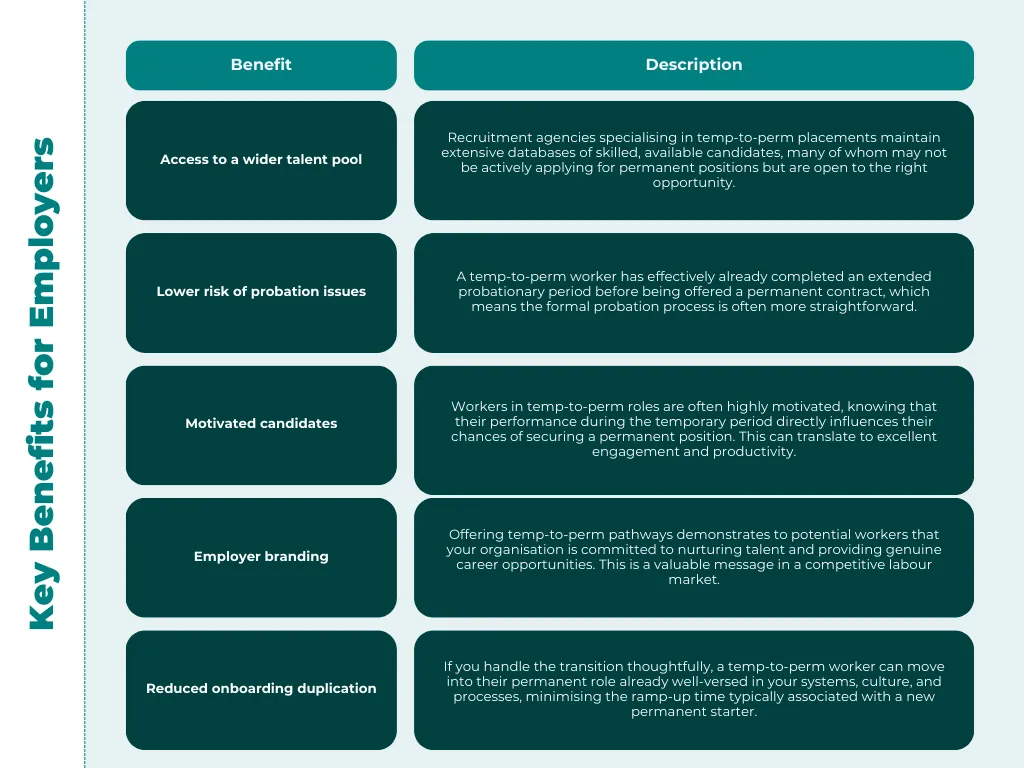
If the transition from temporary to permanent is not managed carefully, there is a risk that the individual goes through two rounds of onboarding, first as a temp and then as a permanent employee, which wastes time and can feel disjointed for the new starter.
Temp to perm can be highly effective for operational, administrative, and mid-level positions, but may be less appropriate for very senior or highly specialised roles where candidates expect clearly defined permanent terms.
When Should a Business Use Temp to Perm?
Temp to perm is not a one-size-fits-all solution, but there are certain scenarios where it is particularly well suited.
– You need to fill a role quickly but want to assess fit before making a permanent offer.
– Your business is growing rapidly and you want to build headcount in a controlled, risk-managed way.
– You’ve had previous experience of poor permanent hires and want to mitigate that risk going forward.
– You’re entering a new market or launching a new function and aren’t yet certain of the exact skills or experience required long-term.
– You operate in a sector with high staff turnover and want to assess commitment and reliability before committing to a permanent contract.
– You have a temporary peak in demand that may lead to a permanent need, and want to use that period to evaluate the individual.
In each of these scenarios, a reputable recruitment agency can help you structure the arrangement correctly, identify the right candidates, and manage the transition smoothly. Learn more about how specialist recruitment support can help you optimise your hiring strategy.
Temp to Perm vs Permanent Hiring
Both temp to perm and direct permanent hiring have their place in a well-rounded recruitment strategy. The right choice depends on your specific circumstances.
Direct permanent hiring is most appropriate when you have a well-defined role with a clear long-term need, when you’re recruiting at a senior or specialist level where the talent market expects permanent terms, and when time allows for a thorough interview process. It can also be more straightforward administratively, as it bypasses the agency worker regulations that apply during a temporary placement.
Temp to perm is more appropriate when speed is a priority, when the role is newly created and the requirements may evolve, when you’ve had difficulties with direct hires in the past, or when flexibility is key to your workforce planning. It’s particularly effective for operational, administrative, and support-level roles where candidates are generally more comfortable with a temporary starting point.
Many businesses use a combination of both approaches, using temp to perm for volume or entry-level hiring and reserving direct permanent recruitment for leadership or highly technical positions.
Conclusion
Temp to perm has established itself as one of the most practical and strategically sound hiring models available to UK businesses today. It combines the speed and flexibility of temporary recruitment with the long-term potential of permanent employment, offering employers a lower-risk, more informed pathway to building a committed, capable workforce.
By using the temporary period as an extended assessment phase, businesses can make permanent hiring decisions with far greater confidence, reduce the financial and operational impact of poor hires, and cultivate a team that genuinely fits their culture and requirements.
Of course, like any hiring model, temp to perm works best when it is well planned, clearly communicated, and supported by an experienced recruitment partner who understands your sector and your needs.
If you’re considering whether a temp-to-perm approach could benefit your business, we’d encourage you to explore the option with a specialist recruitment consultant. At Express Recruitment, we have extensive experience placing candidates in temp-to-perm roles across a wide range of sectors, and we’re here to help you find the right people for the long term.


Frequently Asked Questions
What does temp to perm mean?
Temp to perm refers to a hiring arrangement where a worker begins in a temporary role with the intention or possibility of transitioning into a permanent position after a defined period, typically 12 to 16 weeks,. It allows both the employer and the employee to assess fit before committing to a long-term contract.
Is temp to perm worth it for employers?
For many businesses, yes. Temp to perm significantly reduces the risk of making a poor permanent hire by giving employers a working trial period in which to evaluate a candidate’s performance, skills, and cultural fit. The cost of a conversion fee is typically far lower than the cost of replacing a permanent employee who didn’t work out.
How long does temp to perm usually last?
The temporary phase of a temp-to-perm role typically lasts between 12 and 16 weeks, though this can vary depending on the employer, the role, and the terms agreed with the recruitment agency. Some arrangements may be shorter or longer depending on the circumstances.
Do employers have to make a temp permanent?
No. A temp-to-perm arrangement includes the option to offer permanent employment, but it does not obligate the employer to do so. If the temporary period reveals that the candidate is not the right fit, the employer is not required to convert them to a permanent role. However, it’s important to handle any conclusion of a temporary placement fairly and in accordance with employment legislation.
What is the difference between temp to perm and a fixed-term contract?
A fixed-term contract is a form of direct employment for a specified period, with no explicit pathway to permanency. A temp-to-perm arrangement, by contrast, is typically facilitated through a recruitment agency and is structured with the intention of transitioning to permanent employment. Fixed-term employees also have different statutory rights compared to agency workers.
Can I use temp to perm for any type of role?
Temp to perm can work well across a broad range of roles and sectors, particularly for operational, administrative, and mid-level positions. It may be less suitable for very senior or highly specialised roles where candidates typically expect permanent terms from the outset. A recruitment consultant can advise you on whether temp to perm is appropriate for your specific vacancy.
Related Articles
How to spot Job Scams
How to spot Job Scams Written by Express Recruitment July 11, 2025 A Company is Targeting People with Fake UK Visa Offers We want to warn the public about a serious and ongoing scam involving people impersonating Express Recruitment. Fraudsters are falsely claiming to…
Helping Universities Hire the Right Way in the East Midlands
Helping Universities Hire the Right Way in the East Midlands Written by Express Recruitment May 1, 2025 A More Ethical Approach to University Recruitment If you work in HR or procurement at a university, you’ll know how important it is to get recruitment right. It is…